What our redemption rate actually measured — a correction
On 23 September a Minnesota broker asked a precise question about our redemption figures: did they separate owners selling from junior lienholders redeeming? Going to answer it, we read the records behind the number one at a time instead of trusting the label on them. The label did not survive.
This page is the correction. Three defects, what each cost, what the numbers are now, and what remains unmeasured.
What we published#
Across resolved Minnesota sheriff's-sale windows, Govire published that 34.2% ended with the owner redeeming — 109 of 319 at the time. The figure appeared in our research, in the glossary, on county pages, on every paid property page, and in the machine-readable summary at /llms.txt, always with its denominator and never with the right name.
Defect one: none of those records is a redemption#
There are 109 rows in the tracker carrying the outcome redeemed_by_owner. Read individually on 23 September 2026:
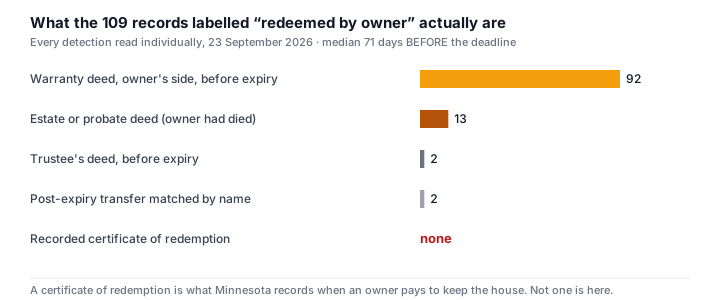
Not one is a certificate of redemption — the document Minnesota records when an owner pays the purchaser and keeps the property under Minn. Stat. 580.23. 107 of the 109 are deeds conveying the property away from the owner's side, recorded a median of 71 days before the deadline. Thirteen are estate or probate deeds: the owner had died and the estate sold.
The detector infers a redemption from the absence of a bank-owned outcome plus the presence of an owner-side sale inside the window. That is a sound test for the certificate did not ripen and a poor proxy for the owner redeemed. We had collapsed two different events into one label.
Defect two: two instruments counted as one#
The same read turned up something the first defect had hidden. Among the windows were condominium and homeowners' association assessment-lien foreclosures under ch. 515B — an association foreclosing a few thousand dollars of unpaid dues, not a lender foreclosing a mortgage.
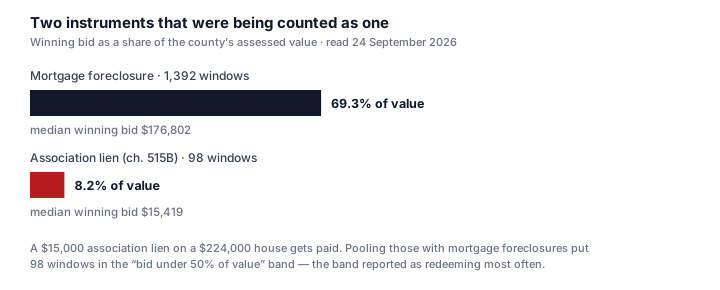
98 windows, median winning bid $15,419 against a median assessed value of $224,200 — 8.2% of value, where mortgage foreclosures run at 69.3%. They resolve differently for an obvious reason: a $15,000 lien on a $224,000 house gets paid, by the owner or by the mortgage lender protecting its position. And because their bids are tiny relative to value, all 98 landed in the "winning bid under 50% of assessed value" band — the band we reported as redeeming most often.
This is the same error we removed on 7 September, when tax-forfeiture windows were found pooled with mortgage redemption windows. Two statutes, two clocks, one estimate.
Defect three: the likeliest real redemptions were excluded#
Seventy-six windows have expired with no bank-owned match and no recorded sale. The checker's own note on each reads "No REO match, no post-expiry sale after full ladder. Possible redemption; needs eCRV/recorder confirmation."
That is the pattern a genuine pay-to-keep redemption leaves: the owner still on title after the deadline, nothing sold, nothing transferred. They sat in an unknown bucket that the published view dropped from the denominator without saying so.
So the figure counted owner-side sales as redemptions, mixed in a different instrument, and excluded the cases most likely to be redemptions.
The corrected figures#
Mortgage foreclosures only, association liens separated, unconfirmed cases counted and shown. Read 24 September 2026:
| Windows | Certificate did not convert | Unconfirmed | Upper bound | |
|---|---|---|---|---|
| All resolved | 324 | 33.0% | 61 | 43.6% |
| Hennepin | 160 | 37.5% | 21 | 44.8% |
| Washington | 66 | 24.2% | 11 | 35.1% |
| Dakota | 62 | 25.8% | 27 | 48.3% |
| Anoka | 34 | 41.2% | 1 | 42.9% |
| Homesteaded | 172 | 37.8% | 32 | 47.5% |
| Not homesteaded | 116 | 23.3% | 27 | 37.8% |
| Bid under 50% of value | 28 | 57.1% | 7 | 65.7% |
| Bid 50–80% | 81 | 42.0% | 12 | 49.5% |
| Bid 80%+ | 51 | 19.6% | 2 | 22.6% |
Three things worth reading in that table.
The headline barely moved — 34.2% to 33.0% — because the errors partly offset. What changed is what the number is for.
The price gradient survived and sharpened. 57.1% under half of value against 19.6% at 80% or more, and the bands do not overlap even at their bounds. A certificate bought cheap relative to value is the one most likely to be paid off before it ripens, because there is equity worth acting on. That finding stands.
Dakota is barely a rate. 27 unconfirmed against 62 resolved: the honest range is 25.8% to 48.3%, which spans the whole question. Publishing 26.2% for Dakota, as we did, implied a precision that was not there. The upper-bound column exists so that can never be hidden again.
What is unmeasured, and how wide it is#
We cannot publish a rate for owners paying to stay. We can publish its bounds. The candidates are the 61 unconfirmed mortgage windows: if every one were a pay-to-keep redemption the rate would be roughly 16% of the 385 windows that have resolved or expired; if none were, near zero.
Anything narrower requires reading certificates of redemption at the county recorder, which we do not parse. The work is smaller than it sounds: 74 of the 76 unconfirmed cases are in Hennepin, Dakota and Washington, so it is three integrations, not eighty-seven.
The junior-lienholder question#
The broker's actual question was whether junior lienholders redeeming under 580.24 were mixed into the owner figure. The answer, from the same evidence: not in the counted bucket, because no redemption certificates of any kind are there — owner, junior creditor or otherwise. A junior-lien redemption would appear either among the 61 unconfirmed cases or, if it led to a later sale, among the outcomes we count as the certificate converting.
When certificates of redemption are parsed, the redeeming party is named on the document, and the split becomes something we report rather than something we infer.
What changed today#
The published view. scoring.redemption_rates now excludes association-lien foreclosures, reports not_converted rather than redeemed, and carries the unconfirmed count and the upper bound as their own columns. The survival curves were rebuilt on the same population, so the two now agree: 107 owner-exit events in the timing series are the same 107 records as the rate.
Every paid property page. The figures block reads "not converted", names the association-lien exclusion, and states in full that it does not measure a homeowner keeping the home.
A bug found on the way. The homestead bucket — the largest cut in the view, 172 windows — had never matched any property, because the rates were computed before the parcel enrichment that carries homestead status was attached. Nothing errored; the block simply rendered one row fewer than it should have. Fixed the same day.
Still to come: the recorder parsing above, the outcome-capture note, and the remaining articles on this site that quote the old figure. They are being corrected in order.
Why publish this#
A figure with a denominator is only as good as the definition behind it, and ours drifted between what the detector could see and what the label claimed. We found it because someone with forty years in the business asked a specific question in public, and we went to check rather than answer from memory.
Every number on this site is computed from records that can be read again. That is what makes a correction possible, and what makes the next one findable too.
Figures read from outcomes.redemption_tracker, scoring.redemption_rates and scoring.redemption_curves on 23–24 September 2026. If you have cited our redemption rate, the safe restatement is: 33.0% of 324 resolved Minnesota mortgage foreclosure windows ended without the sheriff's certificate converting to its holder.