1031 exchange primary residence: can you 1031 a home? The 5-year rule
A 1031 exchange primary residence question — can you 1031 a primary residence — has a short answer and a long one. The short answer is no: Section 1031 defers gain on property held for investment or business, and the house you live in is held for living in. The long answer is that a house can change what it is held for — a home becomes a rental, a rental becomes a home — and the tax code has rules for each direction. Those rules are where the planning is, and where the mistakes are.
This page covers the four situations: selling a home (Section 121, not 1031); exchanging a former home that became a rental; moving into a property acquired through an exchange (the 5-year rule); and combining the two provisions on a property that has been both. It ends with partial exchanges, which are the practical way to take cash out of any of them.
Can you 1031 a primary residence? Why a home does not qualify#
A 1031 primary residence exchange fails at the first requirement: Section 1031 requires that both properties be "held for productive use in a trade or business or for investment." A primary residence is personal-use property. It does not matter that it appreciated, or that you intend to buy another investment with the proceeds; the property being sold has to have been an investment when sold. That is the whole rule, and there is no exception for a large gain.
What the code offers a homeowner instead is Section 121: an exclusion of up to $250,000 of gain ($500,000 married filing jointly) on the sale of a home you have owned and lived in for at least two of the five years before the sale. No replacement property, no deadlines, no intermediary. For most home sales it is the better provision, and it is the reason a homeowner rarely wants a 1031 anyway.
The exchange question arises in the two conversions.
Converting a home to a rental, then exchanging it#
A house you move out of and rent becomes investment property. Once it is genuinely held for investment, it can be exchanged.
How long is "genuinely"? The statute is silent; the cases turn on intent and facts. The safe harbour advisers plan to is Rev. Proc. 2008-16, written for vacation homes but applied by analogy: own the property at least 24 months before the exchange, rent it at fair market value for at least 14 days in each of the two 12-month periods, and keep personal use under 14 days or 10% of the rented days per year. Meet those and the investment-holding requirement is treated as satisfied. A shorter period is arguable, and argued.
The Section 121 overlap. If you lived in the house two of the last five years before the exchange, you can still take the 121 exclusion on the residential gain and defer the rest through the exchange. That is Rev. Proc. 2005-14, and it is the most favourable combination in the code for a landlord who used to live in the property: exclude up to $250,000/$500,000, defer the remainder including depreciation recapture, and roll into a larger investment. The window is the five-year lookback — move out, rent for two years, exchange in year three or four, before the two-of-five residence test lapses.
Moving into a 1031 replacement property: the 5-year rule#
The reverse conversion. You exchange into a rental, hold it as a rental, and later move in. Two rules govern the eventual sale.
The 1031 exchange 5-year rule. Section 121(d)(10) says that if the home was acquired in a 1031 exchange, the Section 121 exclusion is not available unless you have owned it for at least five years from the exchange. This closed the sequence Congress noticed: exchange gain into a house, move in for two years, exclude the gain, repeat. Five years of ownership, of which two must be residence, is the minimum.
The non-qualified-use proration. Since 2009, gain attributable to periods when the property was not your residence ("non-qualified use") after you acquired it is not excludable. Owned eight years, rented for the first six, lived in for the last two: six-eighths of the gain is outside the exclusion, and depreciation taken during the rental years is recaptured regardless. The exclusion covers the residential share only.
And the exchange itself has to have been real. Moving in the month after closing on the replacement invites the IRS to say the property was never held for investment and the exchange fails from the start; the two-year safe harbour above applies in this direction too.
Partial 1031 exchanges: taking cash out#
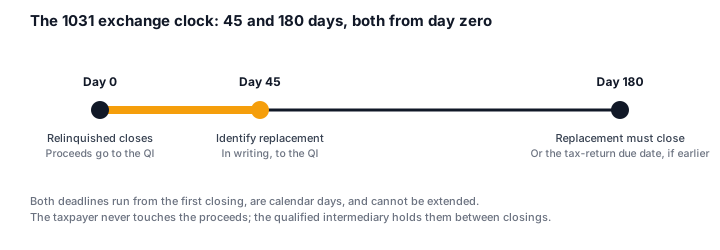
Any of the exchanges above can be partial. If the replacement property costs less than the relinquished one, or you take cash at closing, or the new mortgage is smaller than the old one, the difference is boot and is taxed as gain in the year of the exchange — up to the total gain, with the rest still deferred. A partial exchange is not a failed exchange; it is a deferred exchange with a taxable slice, and it is the normal way to pull equity out of an exchange without giving up the deferral on the balance.
The sequencing matters: boot is recognised first against depreciation recapture, then against capital gain, so a small cash-out is taxed at the recapture rate before it reaches the lower capital-gains rate. Model it before the closing, not after.
The four situations, side by side#
| Situation | Provision | Key conditions | What is excluded or deferred |
|---|---|---|---|
| Sell the home you live in | Section 121 | 2 of 5 years owned and lived in | Up to $250k / $500k of gain excluded |
| Former home, now a rental, exchanged | 1031 (+ 121 if within 5-year lookback) | ~24 months as rental; Rev. Proc. 2005-14 to combine | Residential gain excluded; rest deferred |
| Exchange replacement, later moved into | 121 with 5-year rule | 5 years owned since exchange; 2 of 5 lived in; proration for rental years | Residential share of gain excluded |
| Any of the above, cash taken | Partial 1031 | Boot taxed in year of exchange | Balance deferred |
Minnesota note#
Minnesota conforms to the federal treatment of both provisions, so the same sequencing works for state tax. Two local facts bear on the conversions. Homestead classification changes the property tax bill the year a home becomes a rental — the non-homestead rate is higher — which is an operating cost to put in the rental's numbers during the two-year hold. And a Minnesota property acquired at a sheriff's sale is not owned until the redemption period has run: Govire's outcome data shows 34.2% of 319 tracked windows ended with the owner redeeming, so neither the five-year ownership clock nor the investment-holding period starts on a certificate. It starts on the deed.
For the mechanics of the exchange itself, the 1031 exchange explained; for the party who holds the money, the qualified intermediary; for buying first and selling second, the reverse 1031 exchange.