1031 exchange qualified intermediary: what they do, cost, how to choose
A 1031 exchange qualified intermediary is the party that makes an exchange an exchange rather than a sale. When you sell the relinquished property, the proceeds go to the QI, not to you; the QI holds them while you find a replacement; and the QI pays the replacement's seller at the second closing. You never touch the money, which is the whole requirement, and the QI is the safe harbour that proves it.
This page covers what the QI does at each step, who is disqualified from serving, what one costs, what can go wrong, and what to check before signing the exchange agreement. It assumes you know the basics; the 1031 exchange explained is the starting page.
What a qualified intermediary does#
Before the sale closes. You sign an exchange agreement with the QI, and the purchase agreement for the property you are selling is assigned to the QI. That assignment is what turns the closing into the first leg of an exchange.
At the first closing. The buyer's funds go to the QI's exchange account. The deed goes directly from you to the buyer — the QI does not take title in a standard forward exchange, only the money. The clock starts.
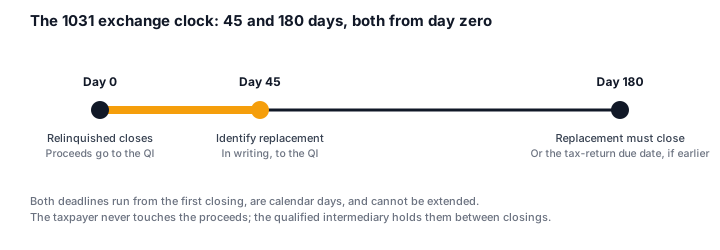
Day 45. You identify replacement property in writing to the QI — up to three properties, or more under the 200% or 95% rules. The QI keeps the identification as the record the IRS will look for.
Before day 180. You contract for the replacement, assign that contract to the QI, and the QI wires the held funds to the seller at closing. Any cash you take out, or any debt not replaced, is boot and is taxable.
After. The QI provides the exchange documents for your return; the exchange is reported on IRS Form 8824.
The QI's legal basis is the deferred-exchange safe harbour in Treasury Regulation 1.1031(k)-1(g)(4): a qualified intermediary who acquires the relinquished property from you, transfers it to the buyer, acquires the replacement, and transfers it to you — on paper, by assignment — is not your agent for constructive-receipt purposes. Every QI's agreement is written to fit that paragraph.
Who cannot be your qualified intermediary#
The same regulation, at (k), defines disqualified persons: anyone who is your agent at the time of the transaction, meaning anyone who has acted as your employee, attorney, accountant, investment banker or broker, or real estate agent or broker, within the two years before the exchange. Related parties — family members and entities you control — are disqualified too, as are entities related to a disqualified person.
In practice: the attorney who closed your last purchase cannot be your QI. Your accountant cannot. Your listing agent cannot. A title company can, and many exchanges are run by title-company subsidiaries set up for the purpose; so can an independent exchange company, or a bank's exchange division. The test is the two-year relationship, not the profession.
What a qualified intermediary costs#
Fees are not regulated and vary by company and by exchange type. For a standard forward exchange with one relinquished and one replacement property, most QIs quote a flat fee in the several-hundred to low-thousands range, with a further fee per additional property; some pay you interest on the held funds and some keep it, which is worth asking. A reverse exchange, where the QI's affiliate — an exchange accommodation titleholder — must take title to the replacement property and hold it, costs several times more, as does an improvement exchange. Compared with the tax deferred, the fee is small; compared with the risk of a bad QI, it is the wrong place to economise.
What can go wrong#
The QI fails. Qualified intermediaries are unregulated in most states, and several have collapsed holding clients' proceeds — the funds were commingled, invested, or simply taken. When that happens the exchange fails and the money may be unrecoverable. The protections are structural: a segregated account per client, ideally requiring your signature to disburse; a fidelity bond; errors-and-omissions cover; and membership of the Federation of Exchange Accommodators, whose members follow a code and, in some states, are the only ones the law recognises.
The QI was hired late. If the relinquished property closes and the proceeds reach you or your attorney's trust account before an exchange agreement exists, there is no exchange. The QI must be in place before the first closing.
The identification was defective. Late, unsigned, sent to the wrong person, or describing the property ambiguously. The QI receives the notice; a good one confirms it in writing and flags a problem while there is still time.
Boot nobody counted. Closing costs paid from exchange funds that are not exchange expenses, or replacement debt lower than relinquished debt, produce taxable gain. The QI documents the flows; the tax adviser reads them.
How to choose a qualified intermediary#
Ask each candidate, in writing:
- How are my funds held? Segregated account in my name, dual signature, at which bank.
- Are you bonded and insured, and for how much? Fidelity bond and E&O policy; ask for the certificates.
- Are you an FEA member, and is your state one that regulates QIs?
- What is the fee, what does it include, and who keeps the interest?
- Who is my contact on the day of closing, and what is their turnaround on identifications and disbursements?
- Have you handled the exchange type I need — reverse, improvement, multi-property — and can you describe one?
- What happens if I miss day 45 or day 180? The honest answer is that the funds are returned and the gain is taxable; a QI that suggests otherwise is one to avoid.
A title company that already handles your closings is often the practical answer, provided its exchange arm is a separate entity with its own bond and the closer has not acted as your agent in the last two years.
Qualified intermediary 1031 exchange rules, in one list#
- Hire the QI before the first closing; assign the sale contract to it.
- Proceeds go to the QI's segregated account, never to you.
- Identify replacements in writing to the QI within 45 days.
- Close on the replacement within 180 days (or your return's due date, if earlier).
- Replace equal or greater value and debt, or pay tax on the difference.
- The QI cannot be a disqualified person; check the two-year rule.
- Report on Form 8824.
Minnesota note#
Minnesota does not license qualified intermediaries, so the protections above are contractual, not statutory. Minnesota real estate — including distressed property bought at a sheriff's sale once the redemption period has run — is like-kind with any other US investment real estate, and a certificate that has ripened into a deed is exchangeable property. A certificate still inside its redemption window is not: the taxpayer does not yet own the real estate. Govire's outcome data shows 34.2% of 319 tracked windows ended with the owner redeeming, so an exchange into a Minnesota certificate is an exchange into a one-in-three chance of a refund instead of a property — a timing problem the 180-day clock does not forgive.
For the related pages: the reverse 1031 exchange, where the QI's affiliate holds title; and 1031 exchange and a primary residence.