How to find liens on a property and run a title search before you buy
How to find liens on a property is the first question a distressed-property buyer has to answer and the one most skip. A lien is a recorded claim against the property that follows it to the next owner, and the record that holds it is public in every county in the country. Finding it costs nothing; missing it costs whatever the lien is worth. This page covers where liens live, how to check for free, what a professional title search adds, what a preliminary title report actually says, and — the part that matters for foreclosure buyers — which liens survive a sale and which do not.
Minnesota is the worked example, because it has two recording systems where most states have one, and because Govire's outcome data shows how often a buyer's title stays unsettled long after the sale.
Where liens on a property are recorded#
Every lien that attaches to real estate is recorded somewhere public. Three places cover almost all of them.
The county recorder. Mortgages, mechanic's liens, assignments, tax liens filed against the parcel, notices of pendency, and in most states judgment liens once they are docketed against the property. Each document has a recording date and number, and the index is searchable by name and, in most counties, by parcel number or address.
The registrar of titles, in states with land registration. Minnesota is one of a handful still running the Torrens system alongside ordinary abstract recording, under Minn. Stat. ch. 508. For Torrens property, the county holds a certificate of title that lists the owner and every current encumbrance on one document; a lien that is not memorialised on the certificate does not bind the land. Roughly half of Hennepin County's parcels are Torrens. The registrar and the recorder are usually the same office with two indexes.
The district court. Money judgments become liens on the debtor's real estate in the county where they are docketed, for ten years in Minnesota. They are indexed by the debtor's name, not by parcel, which is why a search by parcel alone can miss them.
Two further indexes catch what those three do not: the Secretary of State's UCC filings, for fixture filings and certain agricultural liens, and the IRS and state tax-lien indexes, which in Minnesota are filed with the county recorder and searchable by name.
How to check for liens on a property for free#
The free search is a first pass, not a title search, and it is worth doing before spending anything on a property.
- Find the parcel number on the county assessor's site by address.
- Search the recorder's index by parcel or legal description. Hennepin, Ramsey, Anoka, Dakota and Washington counties all offer online indexes; some show document images, some only the index entry. Read every entry with "mortgage", "lien", "assignment", "notice" or "judgment" in it.
- Search the court's judgment index by the owner's name — the Minnesota court records system covers all 87 counties.
- Check the property tax status on the county treasurer's site. Delinquent taxes are a lien senior to everything else on the parcel, and they are the lien most often missed because they live on the tax roll rather than in the recorder's index.
- For Torrens property, pull the certificate of title. It is the one document that lists everything.
What the free search cannot tell you: whether a recorded lien has been paid but not released, whether a name-indexed judgment belongs to this owner or a namesake, or whether an easement exists that the index describes only by a book and page reference. Those are what a title company resolves.
Is there a lien on my house? The common liens and what each means#
A search turns up document names; what they mean decides what you do.
- Mortgage. A voluntary lien securing a loan. Survives or is extinguished by a foreclosure depending on its priority, which is its recording date.
- Mechanic's lien. Filed by a contractor or supplier unpaid for work on the property, under Minn. Stat. ch. 514; it must be recorded within 120 days of the last work and takes priority from the date work visibly began — which can be earlier than a later-recorded mortgage.
- Judgment lien. A court money judgment docketed against the owner; attaches to all their real estate in the county for ten years. Indexed by name.
- Property-tax lien. Not a recorded document at all in Minnesota — unpaid taxes sit on the county roll, senior to everything, until paid or forfeited.
- State and federal tax liens. Recorded with the county by name; federal liens carry their own redemption right after a foreclosure.
- Association lien. Condominium and homeowners' association assessments, with a statutory lien under ch. 515B; junior to a first mortgage in most cases.
- Notice of pendency (lis pendens). Not a lien but a warning that litigation affecting title is pending — a foreclosure by advertisement in Minnesota records one before the sale.
- Utility and city liens. Unpaid water, sewer or nuisance-abatement charges certified to the tax roll, where they become part of the property-tax lien.
If your own search shows one you did not know about, the recorded document names the claimant; a paid lien with no release on record is cleared with a satisfaction from the claimant, and a disputed one is a matter for counsel.
What a professional title search adds#
A title company or abstractor runs the same indexes with two things a buyer lacks: the chain of title back through prior owners, and the training to read what each document does to the title. The output is a preliminary title report — in some markets a title commitment — that lists the vested owner, the legal description, every recorded encumbrance, and the requirements to clear each before a policy issues.
How long does a title search take? One to three business days for an ordinary residential parcel, longer for commercial property, rural land with old easements, or a parcel that has been through probate or foreclosure recently. Torrens property is faster because the certificate is the search.
What it costs. A search alone runs roughly $100–$300 in the Twin Cities; a full closing with an owner's policy is more, and the policy is the point — it is the insurer standing behind the search.
Reading the report. Schedule A is who owns it and what is being insured; Schedule B-I is what must be done before closing (pay off this mortgage, release that lien); Schedule B-II is what the policy will not cover — easements, restrictions, and anything the insurer has decided to exclude. Distressed-property buyers read B-II first.
Deed vs title: why the distinction decides what you get#
Title is the legal right of ownership. A deed is the document that transfers it, and it transfers only what the grantor actually had. A warranty deed promises the grantor holds clear title and will defend it; a quitclaim deed promises nothing, conveying whatever interest the grantor has, clouded or not. A sheriff's certificate is neither — it is a conditional right that becomes title only when every redemption period has expired. Buying at a foreclosure sale is buying a certificate; buying from an estate is buying a personal representative's deed; buying from a bank after foreclosure is buying a special warranty deed that warrants only the bank's period of ownership. The lien search matters differently for each.
Which liens survive a foreclosure sale#
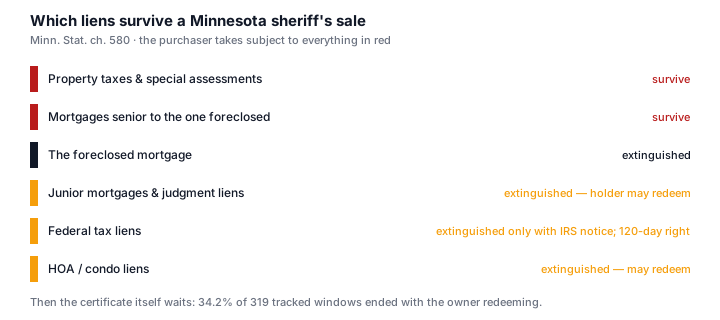
This is where foreclosure buyers lose money, and where the rule is state-specific. Minnesota's, under chapter 580:
| Lien | After a Minnesota sheriff's sale |
|---|---|
| Property taxes and special assessments | Survive. Senior to every mortgage; the purchaser pays them |
| Mortgages senior to the one foreclosed | Survive. The buyer takes subject to them |
| The foreclosed mortgage | Extinguished by the sale |
| Junior mortgages and judgment liens | Extinguished — but the holder may redeem after the owner's period, under 580.24, by paying the purchaser |
| Mechanic's liens | Depends on priority date; those attaching before the foreclosed mortgage survive |
| Federal tax liens | Extinguished only with proper notice to the IRS; otherwise a 120-day federal redemption right |
| HOA and condominium liens | Junior in most cases; extinguished, subject to redemption |
Two consequences follow. First, the opening bid at a sheriff's sale tells you the foreclosing lender's debt, not the property's encumbrances; a $90,000 bid on a $250,000 house with a $60,000 senior mortgage and $8,000 of delinquent taxes is a $158,000 purchase. Second, the certificate you buy is not title until the redemption period under 580.23 has run for the owner and then, in short successive windows, for every junior creditor. Govire follows every window it opens: across 319 resolved Minnesota sheriff's-sale windows, 34.2% ended with the owner redeeming, and 46.5% of 1,353 tracked windows had reached a foreclosure sale by eighteen months against a six-month statute. A lien search tells you what you are buying; the outcome data tells you how long you may wait to own it.
Minnesota specifics worth knowing#
Torrens changes the search. Adverse possession does not run against registered land, unrecorded interests do not bind it, and a foreclosure or tax deed must be memorialised by the registrar before the purchaser's title is complete. Hennepin, Ramsey and the other metro counties each employ an examiner of titles for this. The upside is a short, definitive search; the downside is that a step missed at the registrar leaves the title exactly where it was.
Tax liens live on the roll. Minnesota counties do not sell tax liens; unpaid taxes sit on the county's books and, after a tax judgment and a three-year redemption period, the parcel forfeits to the state. Govire reads Hennepin's roll: 3,113 delinquent parcels as of September 2026, 813 of them three or more years behind. A free search that skips the treasurer's site misses the lien that outranks all the others.
Judgments are by name. The Minnesota court system's public records cover every county; search the owner's name and any prior owner in the last ten years.
A checklist before you bid#
- Parcel number and legal description confirmed against the notice.
- Recorder (or registrar) index read for every mortgage, lien and assignment.
- Property-tax status read on the treasurer's site; delinquent amount noted.
- Judgment index searched by owner's name.
- Senior mortgages identified and added to the opening bid.
- For Torrens: certificate of title pulled.
- Preliminary title report ordered if the numbers still work.
- Redemption exposure understood: whose right, for how long, and the historical odds.
See the data behind the odds#
Govire tracks Minnesota sheriff's sales with the redemption expiry beside each and publishes what happens to them afterwards. The county pages carry the counts; the statewide list ties them together.