What makes buying a foreclosed property risky? Two answers, with numbers
What makes buying a foreclosed property risky comes down to two things, and the question is usually asked as "select two" because the exam answer is a pair. Here is the pair, with the numbers behind each.
Risk one: you may not end up owning it#
In about half of US states, the auction is not the end of the process. The former owner keeps a redemption right — a period after the sale during which they can pay the winning bid plus interest and costs and take the property back. The buyer at the auction receives a certificate, not a deed, and holds it while the clock runs.
Minnesota's period is six months by default under Minn. Stat. 580.23, twelve in defined cases, five weeks where a court finds the property abandoned. Govire follows every window it opens until the county recorder shows the outcome, and the outcome is not rare:
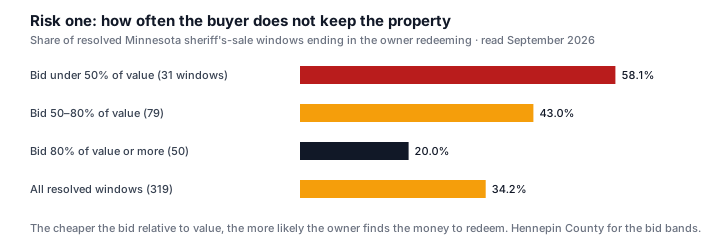
Across 319 resolved Minnesota sheriff's-sale windows, 34.2% ended with the owner redeeming. The odds move with the price: where the winning bid was under half of the home's assessed value, owners redeemed 58.1% of the time (31 Hennepin windows); at 80% of value or more, 20.0% (50 windows). The cheaper the certificate, the more likely someone finds the money to take it back — which is the opposite of what a bargain hunter assumes.
The redeeming owner repays the bid with interest, so the buyer's principal is not lost. What is lost is the property, the months the capital was committed — 46.5% of 1,353 tracked windows had reached a foreclosure sale only by eighteen months, against a six-month statute — and anything spent on the house in the meantime.
Risk two: you buy as-is, and some liens come with it#
A sheriff's sale sells the property on the description in the notice. There is no inspection contingency, no seller disclosure, and usually no way inside: the occupant is often still living there. The buyer prices the roof, the furnace and the water damage from the sidewalk.
And the sale does not clear the title. It extinguishes the mortgage being foreclosed and the liens junior to it. It does not touch property taxes and special assessments, which are senior to everything, or mortgages recorded before the one foreclosed, which the buyer takes subject to. Junior lienholders in Minnesota also keep a redemption right of their own after the owner's period, under 580.24. A $90,000 winning bid on a house with $8,000 of delinquent taxes and a $60,000 senior mortgage is a $158,000 purchase, and the notice does not add it up for you.
Both parts of this risk are readable before the auction. How to find liens on a property covers the search; the county treasurer's site shows the tax balance; the notice shows which mortgage is being foreclosed and, by its recording date, which ones outrank it.
The two risks, side by side#
| You may not keep it | You buy as-is with surviving liens | |
|---|---|---|
| Where it applies | Redemption states (about half); Minnesota: 6 months default | Every state |
| How likely | 34.2% of 319 MN windows; 58.1% on cheap bids | Every purchase carries some; amount varies |
| What you lose | The property and the time; principal is repaid with interest | Repair cost and the surviving debt |
| How to know in advance | The statute, and the outcome data by bid-to-value | A title search and the tax roll, before bidding |
| Priced into the opening bid? | No | No |
Why the answer is different in Minnesota than in Texas#
The two risks are the same everywhere; their size is not. Texas, Georgia, Virginia and roughly half the states have no post-sale redemption — the auction is final, and risk one collapses to the narrow window before the sale. Minnesota, Michigan, Illinois, Iowa, Alabama and the rest keep a redemption period, from a few weeks to two years, and risk one is the dominant one. A buyer who learned foreclosure auctions in a non-redemption state and bids the same way in Minnesota is running a 34% chance of a refund instead of a house, at a discount that was supposed to be the whole point.
Risk two is more uniform, but its size still depends on the county: whether tax liens are sold or held (Minnesota holds them until forfeiture), how quickly the recorder's index is searchable online, and whether the state runs a Torrens system that lists every encumbrance on one certificate — Minnesota does, for about half of Hennepin County.
What is not on the list#
Two things people expect on it that are not the main risks. Losing your principal — in a redemption state the buyer is repaid with interest if the owner redeems, and the lien position of a purchaser at a valid sale is strong. Eviction — an occupant who does not redeem must leave when the period ends, and the process is ordinary; it is a cost and a delay, not a risk to the purchase itself.
Buying anyway, with both priced#
The buyers who do well at foreclosure auctions are not the ones who avoid these risks; they are the ones who measure them. Read the county record for liens and taxes. Read the notice for the redemption period the lender stated. Bid at a price that survives an 80%-of-value redemption rate of 20%, or a half-of-value rate of 58%, whichever band you are in. And know the clock: Govire's county pages carry the redemption expiry beside every tracked sale, because that date, not the auction date, is when a certificate becomes a house.
See the current Minnesota sheriff's sales with redemption dates →
For the whole process, see what a sheriff sale is and how it works; for the certificate you are actually buying, what is a sheriff's certificate.