Wholesaling real estate: how it works, the contract, and the legal line
Wholesaling real estate is the entry point most new investors are sold, and the part of the business most often misdescribed. The mechanics are simple: contract a property below market, sell the contract to someone who will close on it, keep the spread. What is not simple is the law around marketing property you do not own, the contract terms that make the assignment work, and — in Minnesota specifically — the rules that apply the moment the seller is in foreclosure, which is where most wholesaling leads come from.
This page is the full mechanics, the contract, the two ways to get paid, the legal lines by state and in Minnesota, and what the public records say about where the deals are. Its children cover whether wholesaling is legal and double closing versus assignment in more depth.
What is wholesaling real estate?#
Real estate wholesaling is a middleman's business: the wholesaler never owns the inventory. The sequence:
- Find a seller who will sign a purchase agreement at a price below what an investor would pay — usually because the property needs work, the seller needs speed, or both.
- Sign the contract, as the buyer, with a clause permitting assignment and a contingency that lets the wholesaler walk away.
- Find an end buyer — a flipper, landlord or cash buyer — who will pay more than the contract price.
- Assign the contract to the end buyer for a fee, or double close: buy from the seller and resell to the end buyer on the same day.
- The end buyer closes and takes title. The wholesaler is paid at closing.
The spread is the fee. Nationally it runs from a few thousand dollars to $20,000 or more on a house; on the higher-priced end it can be a percentage of the deal. The wholesaler brings no money except earnest money and no credit; what they bring is a seller and a buyer who would not otherwise have met.
How to wholesale real estate: the two halves of the work#
Finding sellers is public-records work. The sellers a wholesaler wants are the ones with a reason to sign below market and quickly: an owner behind on the mortgage or taxes, an estate with a house to clear, a landlord with a vacant or condemned building, an absentee owner tired of a property they do not live near. Every one of those situations is a recorded event — a foreclosure notice, a delinquent tax roll, a vacant-building registration, a probate filing — and Govire reads about 8,500 of them across Minnesota: 1,721 sheriff's sale notices in 44 counties, 3,615 tax-delinquent parcels, 525 registered vacant buildings, 68 probate filings, as of September 2026. How to find distressed properties covers each record type; how to find motivated sellers covers the outreach.
Finding buyers is a list. House wholesalers who last have one; cash buyers who close reliably are a small population in any market, and a wholesaler's real asset is a dozen of them who answer the phone. The list is built from recorded sales — who has been buying distressed property for cash, repeatedly, in the last year — which is exactly what the state's eCRV sale filings show and what Govire's investor mailing list was built from.
The order matters: buyers first. A wholesaler who signs a contract without a buyer is a wholesaler who will default on a seller who needed the sale.
The wholesale real estate contract#
The instrument is a standard purchase agreement — in Minnesota, usually the state bar or realtor form — with three things added or checked:
An assignment clause. "Buyer and/or assigns" in the buyer's name, or an express clause permitting assignment without the seller's consent. Without it, most purchase agreements are assignable anyway under contract law, but a seller who did not expect an assignment is a seller who may refuse to close.
An exit contingency. An inspection period (7–14 days), a financing contingency, or a partner-approval clause — some way for the wholesaler to cancel and recover the earnest money if no end buyer materialises. The ethical line runs here: a contingency used as a free option on someone's house, with no intent to close, is the practice that has drawn state legislation.
Earnest money. Real, and at risk. $500 to $2,000 is typical; a seller who sees $10 knows what is happening.
Disclosure. A growing number of states require the wholesaler to disclose, in the contract, that they may assign it for a profit and do not intend to close themselves. It is good practice everywhere and it defuses the seller's later complaint.
Then the assignment agreement itself: one or two pages between the wholesaler and the end buyer, transferring the purchase agreement in exchange for the assignment fee, usually paid at closing through the settlement statement.
Assignment vs double closing: how the wholesaler gets paid#
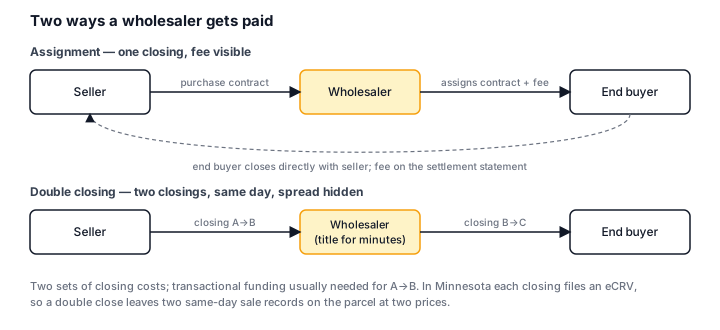
Assignment. The wholesaler steps out; the end buyer steps into the contract and closes with the seller. One closing, one set of costs, and the assignment fee appears on the settlement statement where the seller and the end buyer can see it. Simple, cheap, transparent — and the transparency is the drawback: a seller who sees a $30,000 fee at the table sometimes refuses to sign, and an end buyer who sees it sometimes renegotiates.
Double closing. Two transactions: seller to wholesaler (the A-to-B closing), then wholesaler to end buyer (B-to-C), minutes or hours apart. The wholesaler takes title briefly and the spread is invisible to both other parties. The costs are two sets of closing fees and, because the wholesaler must actually pay the seller before the end buyer's money arrives, usually a day of transactional funding at a flat fee. Title companies vary on whether they will run the B-to-C closing off the A-to-B proceeds; some states restrict it. The double closing vs assignment page goes through the arithmetic.
In Minnesota both closings record an eCRV with the state, so a double close leaves two same-day sale filings on the parcel, at two prices. That is how the practice shows in the public record — and how a county assessor, or anyone reading the filings, sees the spread the parties did not.
Is wholesaling real estate legal? The lines by state and in Minnesota#
The practice is legal in most states, and the question is really three narrower ones.
Are you brokering without a license? Every state licenses people who, for compensation, market or negotiate the sale of real estate they do not own. A wholesaler who assigns their own contract is selling their own contractual interest, which is not brokerage. A wholesaler who advertises the house — photos, price, "for sale" — before they own it, or who negotiates on the seller's behalf with buyers, looks like an unlicensed agent. Illinois, Oklahoma, South Carolina and others have written wholesaling into their licensing statutes in recent years; Pennsylvania and Virginia require registration or disclosure. Check the state.
Is the seller in foreclosure? This is the Minnesota line, and it does not depend on licensing. Chapter 325N governs anyone who contracts to buy a residence from an owner in foreclosure — an "equity purchaser" — with required contract terms, a five-business-day cancellation right for the owner, and civil and criminal penalties. A wholesaler contracting with an owner who has received a foreclosure notice is an equity purchaser whether or not they intend to close. Assigning that contract does not shed the obligations; it passes a 325N contract to an end buyer who now holds it.
Did you misrepresent? Telling a seller you will close when you have no buyer and no money is the fact pattern behind most enforcement. The disclosure clause above is the cure.
Minnesota has no wholesaling statute. Its licensing law, Chapter 82, defines a broker as anyone who for compensation negotiates or offers to negotiate the sale of real estate for another; the Department of Commerce has treated volume marketing of unowned property as brokerage. Assigning a contract you are a party to is not, as the law stands; marketing the property is the risk.
What the end buyer inherits#
The wholesaler's fee is earned when the end buyer closes; the end buyer is the one who owns the outcome. In Minnesota that outcome includes a fact most out-of-state investors miss: if the seller was in foreclosure and the sale closes after the sheriff's sale, the property is inside a redemption period, and the former owner — or a junior lienholder — may still redeem it. Across 319 resolved sheriff's-sale windows Govire has tracked, 34.2% ended with the owner redeeming; where the winning bid was under half the home's assessed value, 58.1% did (31 Hennepin windows). A wholesaler selling a contract on a house in redemption is selling a certificate's risk, and an end buyer who does not know it is paying full price for a coin flip.
Which is why the wholesaler's due diligence is the end buyer's due diligence: find the liens, read the notice, and know whose right to redeem is still running.
A worked example, Minnesota#
A Hibbing house, assessed at $109,000, owner four payments behind and served with a foreclosure notice. Wholesaler contracts it at $62,000 with a 10-day inspection contingency, $1,000 earnest, an assignment clause, and — because the owner is in foreclosure — a 325N-compliant contract with the five-day cancellation notice. End buyer, a local landlord, agrees to $74,000. Assignment fee $12,000, paid at closing.
Three things could break it. The owner cancels within five business days under 325N. The title search shows a $9,000 delinquent-tax lien the contract price did not account for, and the end buyer renegotiates. Or the sale closes before the sheriff's sale is cancelled and the end buyer's title is now a redemption exposure the wholesaler never mentioned. Each is a contract clause or a records search; none is a surprise to a wholesaler who reads the county before signing.
Where wholesaling is headed#
The trend in state law is toward disclosure and, in some states, licensing. The trend in the market is toward records: the wholesalers who last are the ones who find sellers through the public record rather than through blanket mail, and who know before they sign whether the house is in a redemption window, on a delinquent roll or on a vacant-building register. That is a data problem before it is a sales problem, and it is the part Govire is built for.