HELOC on investment property: who lends, at what LTV, and the tax deduction
A HELOC on investment property is the same instrument as the one on your house — a revolving line secured by the equity, drawn as needed, interest on what you use — with three differences that decide whether you can get one: fewer lenders offer it, they lend against less of the equity, and they charge more for it. The tax treatment differs too, and in the investor's favour when the money goes into the property.
This page covers who lends, at what loan-to-value and rate, how the interest deduction actually works, the HELOC-versus-cash-out choice, and what to check before opening one.
Who writes a HELOC on an investment property#
Most large national banks do not. Their HELOC programs are built for primary and second homes, and a rental is declined at application. The lenders who do write them:
- Credit unions, especially those with commercial or member-business lending desks, are the most common source and often the cheapest.
- Community and regional banks that hold loans on their own books — portfolio lenders — can price a rental HELOC as they choose.
- A handful of national lenders that specialise in investor products, sometimes as a fixed-rate home equity loan rather than a true line.
What they require, beyond the property: a credit score typically 700 or better, reserves, a lease or rent schedule showing the property carries itself, and a limit on how many financed properties you hold. A rental in an LLC narrows the field further; some lenders require personal title.
Loan-to-value, rate and term#
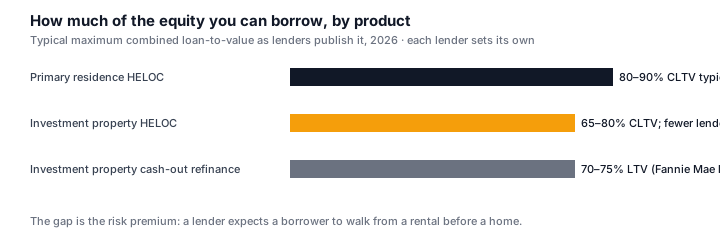
The number that matters is combined loan-to-value — the first mortgage plus the new line, as a share of appraised value. On a primary residence lenders commonly go to 80–90% CLTV. On an investment property the ceiling is usually 65–80%, and 75% is a common cap. The arithmetic on a $300,000 rental carrying a $180,000 first mortgage:
| Primary residence, 85% CLTV | Investment property, 75% CLTV | |
|---|---|---|
| Maximum total debt | $255,000 | $225,000 |
| Less first mortgage | $180,000 | $180,000 |
| Available line | $75,000 | $45,000 |
Same equity, 40% less line. The gap is a risk premium in disguise: a lender expects a borrower under stress to stop paying on a rental before a home.
Rate. Variable, indexed to prime, and a margin above what the same lender charges on a primary-residence HELOC — commonly one to two points. Some lenders offer a fixed-rate draw option or a fixed-rate home equity loan on investment property instead, which trades the flexibility for a rate that does not reset.
Term. A 10-year draw period, interest-only, then a 10–20-year repayment period with amortising payments — the same shape as any HELOC. The payment jump at the end of the draw period is the one investors forget to model.
Is HELOC interest tax deductible on an investment property?#
The rule is about use, not collateral. The IRS traces borrowed money to what it was spent on (Publication 535, interest allocation), and the interest follows the use:
- Spent on the rental that secures it — repairs, a roof, a kitchen — the interest is a rental expense on Schedule E, deductible against the rental's income.
- Spent on another rental or investment — a down payment on the next property — the interest is deductible against that investment, again on Schedule E or as investment interest.
- Spent on personal use — a car, a vacation, paying down a personal card — the interest is not deductible at all.
Two things do not apply. The home mortgage interest deduction in Publication 936 and its $750,000 cap are for a qualified residence, which a rental is not; the deduction here is a business expense, uncapped but limited to what the rental and your other passive income can absorb. And the 2018 rule that HELOC interest is deductible only if used to buy, build or improve the home that secures it is a home-mortgage rule; the tracing rules for rental property are older and broader. Keep the draw records: the tracing is yours to prove.
HELOC vs cash-out refinance on a rental#
| HELOC | Cash-out refinance | |
|---|---|---|
| First mortgage | Stays, at its existing rate | Replaced, at today's rate |
| Amount | Up to the CLTV cap, drawn as needed | Up to 70–75% LTV, in one sum |
| Rate | Variable, interest-only in draw period | Fixed for the term |
| Closing costs | Low, sometimes none | Full — 2–4% of the new loan |
| Interest charged on | What you draw | The whole balance |
| Seasoning | Usually 6–12 months of ownership | 6–12 months; delayed-financing exception for cash purchases |
| Suits | Rehab, bridge, a replaceable down payment | Permanent leverage, or when the old rate is worth giving up |
The short version: if the first mortgage was written at a rate you would not get today, a HELOC protects it and a refinance destroys it. If you need a large fixed sum for a long hold, the refinance is the honest product. BRRRR investors use both in sequence — a HELOC on one property to fund the purchase and rehab of the next, then a cash-out refinance on the new one to repay the line. The DSCR loan requirements page covers how that refinance is underwritten.
Are HELOCs a good idea for investors? When yes, when no#
Yes, when the use is short and repayable: a rehab funded on the line and repaid from the refinance; a down payment replaced when the next property's cash-out closes; a bridge across a redemption window while a certificate ripens. No, when the line becomes permanent leverage at a variable rate — the payment resets with prime, then jumps again when the draw period ends, and a lender can freeze the line when values fall. The test is whether there is a dated event that repays it.
What to check before opening one#
- The CLTV cap and the appraisal. The lender's appraisal, not your estimate, sets the line; on a rental it is often conservative.
- Whether the property must be in your name. LLC-held rentals are excluded by many programs.
- Draw and repayment periods, and the payment when the draw period ends.
- Rate floor, cap and margin. A variable rate with no cap is a variable rate with no cap.
- Annual fees, inactivity fees, early-closure fees. Small, and they add up on a line you keep open for years.
- How the draw affects the next purchase. A drawn HELOC is a monthly payment in the DTI or DSCR calculation on whatever you buy next.
- Whether the lender will freeze the line. Lenders can reduce or freeze a HELOC when values fall or your credit changes; a line you were counting on for a rehab can disappear mid-project.
Minnesota note#
Rental licensing in Minneapolis and Saint Paul is an operating expense a lender's underwriter will deduct when checking that the property carries itself, and non-homestead property tax classification raises the tax line above what the seller's bill showed — both reduce the income side of the lender's test. On the value side, what Minnesota rentals actually sell for is in the state's eCRV records: distressed Hennepin property sold direct from the owner at a $294,900 median across 393 sales through July 2026. An appraiser's value for a HELOC will be set against recorded sales like those, not against listings.