Owner financing: how it works, who holds the deed, what the records show
Owner financing is the oldest way to buy a house without a bank, and in distressed property it is one of the most common — and least understood. The seller is the lender. The buyer pays over time. Everything else — who holds the deed, who pays the taxes, what happens on default, whether the seller's own mortgage is still underneath — depends on which of three instruments you sign, and buyers regularly sign one thinking it is another.
This page explains the three structures, the questions that decide which you are in, and what Minnesota's sale records show about how seller-financed deals actually perform.
What owner financing (seller financing) means#
In a conventional purchase the buyer borrows from a lender, pays the seller in full at closing, and owes the lender. In owner financing (also seller financing, owner finance, seller carry-back) the seller accepts part or all of the price as a promise to pay, secured by the property. The seller gets a stream of payments and interest; the buyer gets a house without qualifying at a bank; both get a contract that a court will read literally.
Sellers offer it for three reasons: the property will not qualify for conventional financing (condition, title, zoning), the buyer will not qualify (credit, income documentation, self-employment), or the seller wants the income stream and a higher price. The third reason is why owner-financed prices run above market — the seller is being paid for the credit risk. That shows in the data below.
The three structures, and who holds the deed in each#
Contract for deed (land contract). The seller keeps legal title. The buyer takes possession, holds equitable title, pays the instalments, the taxes and the insurance, and receives the deed when the last payment clears — often after a balloon at five or ten years. In Minnesota the contract must be recorded within four months under Minn. Stat. 507.235, which is how it becomes visible in the county records and in Govire's data. This is the structure most owner-financed deals in the Midwest use, and it is the one where the buyer holds the least.
Seller-carried mortgage. The buyer receives the deed at closing and gives the seller a note and mortgage, exactly as a bank would take. The buyer holds legal title; the seller holds a lien and, on default, must foreclose like any lender — in Minnesota, by advertisement with the six-week notice and the six-month redemption period. This is the structure that protects the buyer most and sellers accept least.
Wraparound mortgage. A seller-carried mortgage where the seller's own existing loan stays in place underneath. The buyer pays the seller on the larger "wrap" note; the seller keeps paying the original lender out of it and pockets the spread. It works until the seller stops paying the underlying loan, at which point the buyer discovers the property is being foreclosed by a lender they never dealt with. A wraparound mortgage is only as safe as the seller's bookkeeping.
Subject-to is the mirror image: the buyer takes the deed subject to the seller's existing mortgage and simply makes the payments, with the loan still in the seller's name. The lender is not told. Nearly every residential mortgage contains a due-on-sale clause, so the lender may call the loan when it learns of the transfer; that risk is the deal's price, and it does not go away.
| Contract for deed | Seller-carried mortgage | Wraparound | Subject-to | |
|---|---|---|---|---|
| Legal title | Seller until paid | Buyer | Buyer | Buyer |
| Buyer holds | Equitable title | Title, subject to lien | Title, subject to lien | Title, subject to seller's loan |
| Pays the taxes | Buyer | Buyer | Buyer | Buyer |
| Seller's old mortgage | Usually paid off, sometimes not | Paid off | Stays underneath | Stays, in seller's name |
| On default | Cancellation, 60 days | Foreclosure + redemption | Foreclosure + redemption | Lender may foreclose seller |
| Recorded? | Must be, 4 months | Yes | Yes | Deed yes; loan unchanged |
Who pays property taxes on a land contract#
The buyer, from the day of possession. The contract assigns taxes, insurance and maintenance to the buyer even though the seller holds the deed, and unpaid taxes do two things at once: they become a lien senior to everyone's interest in the parcel, and they are a default under the contract that lets the seller cancel. Minnesota's delinquent tax rolls are where that shows up — see the record below.
What Minnesota's sale records show#
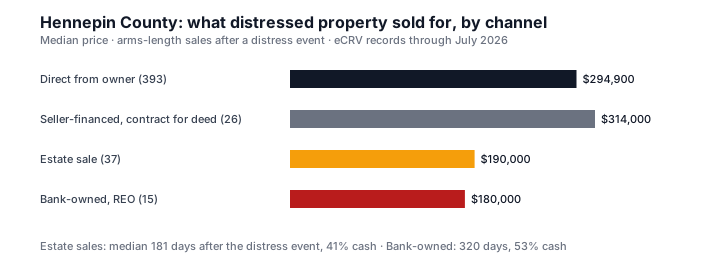
Govire matched roughly two and a half years of the state's eCRV sale filings, through July 2026, against county distress records. In Hennepin County, sales of distressed property by channel:
| Channel | Sales | Median price | Cash buyers | Median days from distress event |
|---|---|---|---|---|
| Direct from owner, bank financed or cash | 393 | $294,900 | 38% | 209 |
| Estate sale | 37 | $190,000 | 41% | 181 |
| Contract for deed (seller-financed) | 26 | $314,000 | 4% | 173 |
| Bank-owned resale | 15 | $180,000 | 53% | 320 |
Three readings. Seller-financed buyers paid the highest median price of any channel — $314,000 against $294,900 for buyers who brought their own financing — which is the credit-risk premium in the record. They closed fastest, at 173 days from the distress event, because there was no lender to satisfy. And 4% paid cash, because a buyer with cash does not need the seller to carry.
The fourth reading is the one that matters. Following those 26 buyers forward, several appeared on the property-tax delinquency roll within their first year of ownership, including on seven-figure purchases. A buyer who could not get a bank loan, paying above market with a balloon ahead, is a buyer the tax roll will find. If you are offered a contract for deed, the honest question is why the bank was not; if you are a seller considering offering one, the same caution runs in reverse.
What happens on default: cancellation vs foreclosure#
This is the largest practical difference between the structures, and in Minnesota it is written into statute.
A contract for deed is cancelled, not foreclosed. Under Minn. Stat. 559.21 the seller serves a notice of cancellation; the buyer has 60 days to cure the default (30 days on some older contracts, longer where a large share has been paid), and if it is not cured the contract terminates, the buyer's equitable title is extinguished, and the seller keeps the property and every payment made. There is no sheriff's sale, no redemption period, no surplus. The buyer's protection is the cure period and, in some cases, a statutory right to a share of paid principal — read the contract.
A seller-carried mortgage or a wraparound is foreclosed like any mortgage: published notice, sheriff's sale, and the buyer's six-month redemption right under 580.23. Across 319 resolved Minnesota windows Govire has tracked, 34.2% ended with the owner redeeming; a contract-for-deed buyer never gets that chance.
A subject-to default is the seller's problem on paper and the buyer's in fact: the lender forecloses the loan in the seller's name, and the buyer, who holds the deed, is the owner who loses the house.
Terms to settle before signing#
- Which instrument — ask for the document's title and read the first page. "Contract for deed" and "land contract" mean the seller keeps title.
- Interest rate and amortisation, and whether there is a balloon and when. Owner-financed balloons at year five are where most cancellations begin.
- Whether the seller's own mortgage is paid off, or stays underneath (wrap) or in place (subject-to). Get the payoff statement.
- Who insures, who pays taxes, who maintains — in writing.
- The cure period on default and whether principal paid is refundable.
- A recorded instrument. An unrecorded contract for deed is invisible to the world and to the buyer's own protection.
- A title search first — the seller can only finance what the seller owns clear. How to find liens on a property is the place to start.
Minnesota's Chapter 325N applies when the seller is in foreclosure: an investor buying from an owner in redemption, on any of these structures, is an equity purchaser with statutory disclosure and cancellation duties.
See the sales behind the figures#
The channel table above is on the data view, sale by sale, where the contract-for-deed filings sit beside the parcel record and the tax roll.
For the other paths, see buying foreclosed homes in Minnesota and DSCR loan requirements.