What is NOI in real estate? Net operating income, formula, worked example
What is NOI in real estate? Net operating income: what a property earns from operations in a year, after the costs of running it and before the cost of financing it. It is the number every other investment metric is built on — the cap rate is NOI over price, the DSCR is NOI over debt payments, and a commercial appraisal is NOI divided by a market cap rate — which is why getting it wrong by one line item is the most expensive small mistake in rental underwriting.
How to calculate NOI: the formula#
NOI = effective gross income − operating expenses. In plain words, NOI means what the building earns before anyone gets paid for lending on it.
Where:
- Gross scheduled rent is every unit at its contract or market rent for twelve months.
- Plus other income: laundry, parking, storage, pet fees, late fees.
- Less vacancy and credit loss: an allowance for units empty between tenants and rent not collected — 5% is the usual placeholder; the property's own history is better.
- = Effective gross income (EGI)
- Less operating expenses: property taxes, insurance, repairs and maintenance, property management, utilities the owner pays (water, sewer, trash, common-area electric, heat in many Minnesota duplexes), rental licensing and inspection fees, lawn and snow, and — in careful underwriting — a reserve for replacements.
- = NOI
Three things are not operating expenses and stay out: debt service (principal and interest on the mortgage), depreciation (a tax figure, not a cash one), and capital expenditures (a roof, a furnace — funded from reserves, not from the operating line). Income tax is out too; NOI is pre-tax.
The definition comes from the appraisal profession and the lenders who rely on it: the Appraisal Institute treats NOI as the income capitalised in the income approach, and Fannie Mae's multifamily underwriting is built on the same line. What goes on the operating line is therefore not a matter of taste — a reserve for replacements, for instance, is standard in appraisal NOI and often left out of a seller's pro forma, and the gap between the two is the first thing a buyer should reconcile.
Where the expense ratio comes from#
Underwriters sanity-check an NOI by its expense ratio — operating expenses as a share of effective gross income. Small older multifamily in the Twin Cities typically runs 35–45%; a pro forma at 20% is missing lines. The reasons Minnesota ratios sit toward the top of that range are specific: non-homestead property tax classification, heating costs the owner often carries in older duplexes, and city rental licensing with periodic inspections that generate repair orders. None is large alone; together they are the difference between a 6.9% cap rate and a 5.5% one on the same building.
A worked example: a Minneapolis duplex#
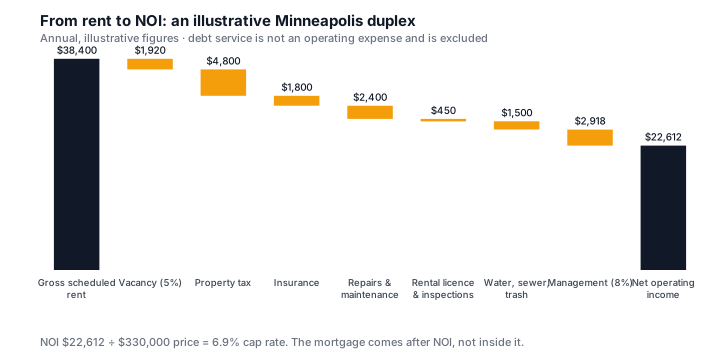
Illustrative figures, not a record. Two units at $1,600 a month:
| Line | Annual |
|---|---|
| Gross scheduled rent (2 × $1,600 × 12) | $38,400 |
| Less vacancy, 5% | −$1,920 |
| Effective gross income | $36,480 |
| Property tax | −$4,800 |
| Insurance | −$1,800 |
| Repairs and maintenance | −$2,400 |
| Rental licence and inspections | −$450 |
| Water, sewer, trash | −$1,500 |
| Management, 8% of EGI | −$2,918 |
| NOI | $22,612 |
At a $330,000 price that is a 6.9% cap rate. If the mortgage on it costs $18,000 a year, the DSCR is 1.26 and the pre-tax cash flow is $4,612 — both derived from the NOI, neither part of it.
Two Minnesota lines worth noticing. Rental licensing is a real operating expense here — Minneapolis and Saint Paul both license rentals, with tiered inspection cycles, and the fee belongs on the line. And property tax is the largest single expense on most Twin Cities rentals; non-homestead classification raises it, and it is the expense buyers most often carry over from the seller's homestead-rate bill.
NOI in real estate vs cash flow: why the mortgage stays out#
NOI describes the property; cash flow describes the deal. A property has one NOI whoever buys it; it has as many cash flows as there are ways to finance it. That separation is what makes NOI the comparison number — a buyer paying cash and a buyer at 75% loan-to-value can look at the same NOI and each compute their own return from it — and what makes it the lender's number: a DSCR loan is underwritten on NOI against the proposed debt service, with the borrower's income beside the point.
It is also the valuation number. Commercial and multi-family property is priced as NOI divided by a market cap rate, so every dollar of NOI is worth 1 ÷ cap rate in price. At a 7% cap, $1,000 of NOI is roughly $14,300 of value, which is why the "how to increase NOI" question is really "how to increase price."
How to increase NOI#
Income side. Rent to market, and know what market is — Minneapolis duplex rents vary by neighbourhood more than by unit. Add income lines: storage, parking, laundry, pet rent. Cut vacancy with turnover speed rather than with lower rent.
Expense side. Appeal the property tax assessment if the county's value is above what comparable sales support; Govire's eCRV data is what those comparable sales are. Rebid insurance annually. Submeter utilities where the units allow it. Self-manage if the numbers and the time both allow it, or renegotiate the management fee against the EGI.
What not to do. Leave repairs out to flatter the NOI. A seller's pro forma with $600 of annual maintenance on a 1920s duplex is not an NOI, it is a wish; buyers underwrite to their own expense ratios, typically 35–45% of EGI for older small multifamily, and the difference between the seller's number and the buyer's is where the price negotiation lives.
NOI in the metrics that follow from it#
| Metric | Formula | Uses NOI? |
|---|---|---|
| Cap rate | NOI ÷ price | Yes |
| DSCR | NOI ÷ annual debt service | Yes |
| Value (income approach) | NOI ÷ market cap rate | Yes |
| Cash flow | NOI − debt service | Yes, as the starting point |
| Cash-on-cash return | cash flow ÷ cash invested | Indirectly |
| Gross rent multiplier | price ÷ gross rent | No — that is its weakness |
The cap rate calculator and DSCR calculator both take NOI as an input; the cash-on-cash calculator takes what is left after the mortgage.
What the sale records add#
NOI is a forward estimate; the price is a recorded fact. Minnesota's eCRV filings record what rental and distressed property actually sold for — in Hennepin County, distressed property sold direct from the owner at a $294,900 median across 393 sales, and bank-owned resales at $180,000 across 15, through July 2026. Set an NOI against a recorded price rather than a listing price and the cap rate you compute is the one the market cleared at.